
-
By Zinova Coating
-
February 8, 2024
- 0 Comment
Zinc Flake Coating Explained: Why Gujarat’s Manufacturers Are Switching from Electroplating
Corrosion is one of the most expensive problems in manufacturing. A single rusted bolt on a chassis assembly, a corroded fastener on a marine deck fitting, or a failed bracket on a railway bogie can lead to warranty claims, safety recalls, or costly field failures. For manufacturers across Gujarat’s automotive, marine, and railway sectors, the coating applied to a fastener often matters as much as the metal it’s made from.
This is where zinc flake coating has become the preferred choice over older methods like electroplating and hot-dip galvanising and understanding why can help engineering and procurement teams make better sourcing decisions.
What Is Zinc Flake Coating?
Zinc flake coating is a surface treatment process where overlapping layers of zinc and aluminium flakes are bonded to a metal component’s surface, typically through a dip-spin application method followed by controlled oven curing. Unlike electroplating, which deposits metal through an electrochemical bath, zinc flake coating forms a thin, mechanically bonded barrier that shields the base metal from moisture, salt, and atmospheric contaminants without altering the component’s core structure.
The result is a coating that’s typically applied in layers of just 8 to 20 microns, thin enough to preserve exact thread geometry and dimensional tolerances, yet dense enough to deliver hundreds of hours of salt spray resistance.
Why Zinc Flake Outperforms Electroplating and Hot-Dip Galvanising
No Hydrogen Embrittlement Risk
Electroplating processes introduce hydrogen into the base metal during the electrochemical reaction. For high-tensile fasteners Grade 8.8, 10.9, and 12.9 this hydrogen can become trapped inside the metal and cause micro-cracking under load, sometimes months after installation. Zinc flake coating is applied without electrolysis, which eliminates this risk entirely. This makes it the standard specification for safety-critical automotive and structural fasteners across global OEM supply chains.
Preserved Thread Geometry and Torque-Tension Accuracy
Hot-dip galvanising builds up a relatively thick and uneven coating layer, which can distort thread profiles and force manufacturers to re-tap threads after coating. Zinc flake’s thin, uniform application avoids this problem, keeping torque-tension performance predictable and consistent across automated assembly lines a critical requirement for automotive Tier-1 suppliers working to tight assembly tolerances.
Environmental Compliance
Modern zinc flake systems are RoHS-compliant and free of hexavalent chromium, meeting the environmental standards required by European automotive OEMs, Indian Railways specifications, and international marine classification bodies. Older galvanising and chromate-based processes often fall short of these requirements, making zinc flake the more export-ready option.
Consistent Friction Control
For threaded fasteners, an unpredictable coefficient of friction leads to inconsistent clamp force a serious quality risk on an assembly line. Zinc flake basecoat and topcoat systems can be precisely calibrated within a friction range (commonly 0.09–0.18), giving manufacturers repeatable, predictable fastening performance batch after batch.
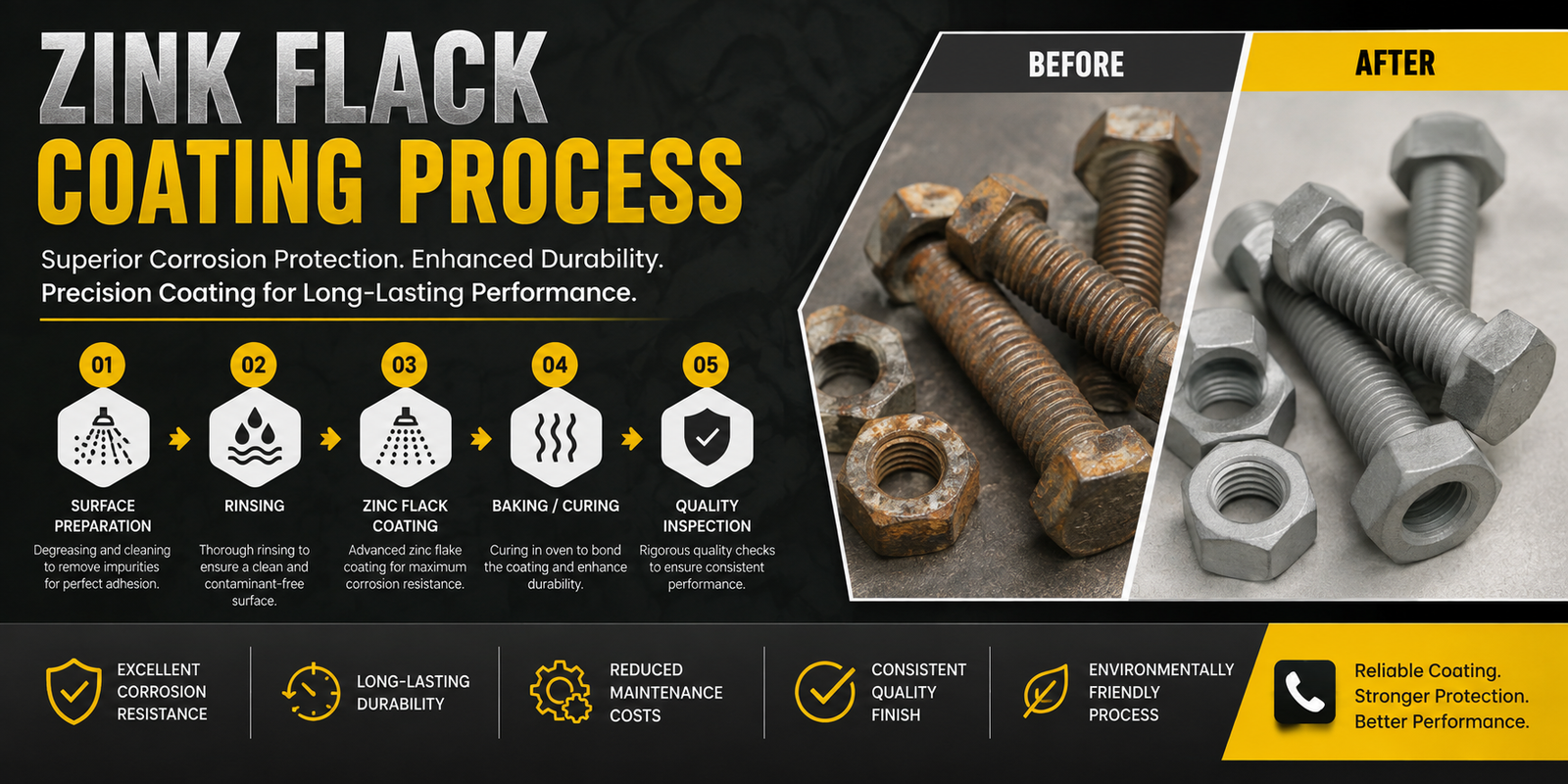
The Zinc Flake Coating Process, Step by Step
A properly executed zinc flake coating follows a disciplined, multi-stage process:
- Degreasing – Components are cleaned in a chemical degreasing tank to remove oils, machining fluids, and surface contaminants, creating a surface ready for coating adhesion.
- Shot Blasting – Automatic shot blasting removes rust, mill scale, and oxidation, producing the controlled surface roughness needed for the coating to bond properly.
- Dip-Spin Application – Components are dipped in the zinc flake coating and spun to remove excess material, ensuring uniform thickness and full coverage, even on complex geometries like fastener threads and recessed heads.
- Oven Curing – Coated parts pass through a conveyorised oven at controlled temperatures around 300°C, chemically bonding the coating to the substrate for maximum adhesion and long-term durability.
- Inspection and Documentation – Every batch is checked against process parameters and test data before dispatch, ensuring traceability for OEM qualification and export documentation.
This level of process control is what separates a reliable industrial coating partner
Where Zinc Flake Coating Is Used
Zinc flake coating has become the specification of choice across several demanding industries:
- Automotive – High-tensile fasteners for chassis, engine, and suspension assemblies, particularly around manufacturing hubs like Sanad and Ankleshwar, where OEMs require RoHS-compliant, hydrogen-embrittlement-free coatings.
- Marine and Offshore – Deck fittings, anchor hardware, hull fasteners, and structural connectors along Gujarat’s coastal belt — Bhavnagar, Jamnagar, and Kutch — where continuous salt spray exposure demands coatings rated for 1,000+ hours of corrosion resistance.
- Railway – Undercarriage bolts, bogie components, and track fasteners across the Rajkot–Dholera corridor, where components must withstand decades of vibration and load cycling without corrosion-related failure.
- General Industrial Hardware – Equipment components operating in humid, coastal, or chemically aggressive environments where standard plating simply doesn’t hold up.
Zinova Coating, based in Bakrol Bujrang, Ahmedabad, provides engineering-grade zinc flake coating solutions for manufacturers across Gujarat’s automotive, marine, and railway industries. From degreasing and shot blasting to dip-spin application and controlled oven curing, every batch is processed with documented quality control. For a free technical consultation on the right coating specification for your components, contact the Zinova Coating team at info@zinovacoating.com or +91 7600256691.
from a generic finishing shop.